.jpg)
Introduction
The TranslationOS connector for Marketo Engages makes it easy to entrust Translated with the professional or automated translation of your assets, saving you the hassle of importing and exporting content or switching between tools.
This connector is event-based, meaning it is triggered by specific actions. To learn which actions trigger the connector, see the section Requesting translations.
Support
For general questions about functionality, our dedicated support team can be reached at info-tos@translated.com.
If you need technical information or you’re ready to integrate your Marketo Engage instance with TranslationOS, feel free to reach out to us at api@translated.com for assistance with onboarding.
The onboarding process may vary depending on your needs, but the following steps are a helpful guideline:
-
Translated will ask you to provide the base URL, the client ID and client secret (see below for instructions to retrieve them).
-
Translated will enable you to test the connector in sandbox mode, which means that you will get back machine-translated content to test the user experience.
-
You will agree with Translated on the required service levels, also known as service types. Translated will take care of configuring the connector for you.
-
We will be ready to receive, process and deliver your translation requests!
Setting up the connector
You will need to retrieve the following three pieces of data from Marketo Engage and communicate them to Translated. We will then complete the connector configuration for you.
Retrieving the base URL
The base URL contains the account ID (aka Munchkin ID) and is therefore unique to each Marketo Engage subscription. Your base URL is found by logging in to Marketo Engage and navigating to Admin > Integration > Web Services. It is labeled “Endpoint:” in the “REST API” section, as shown in the following screenshot.
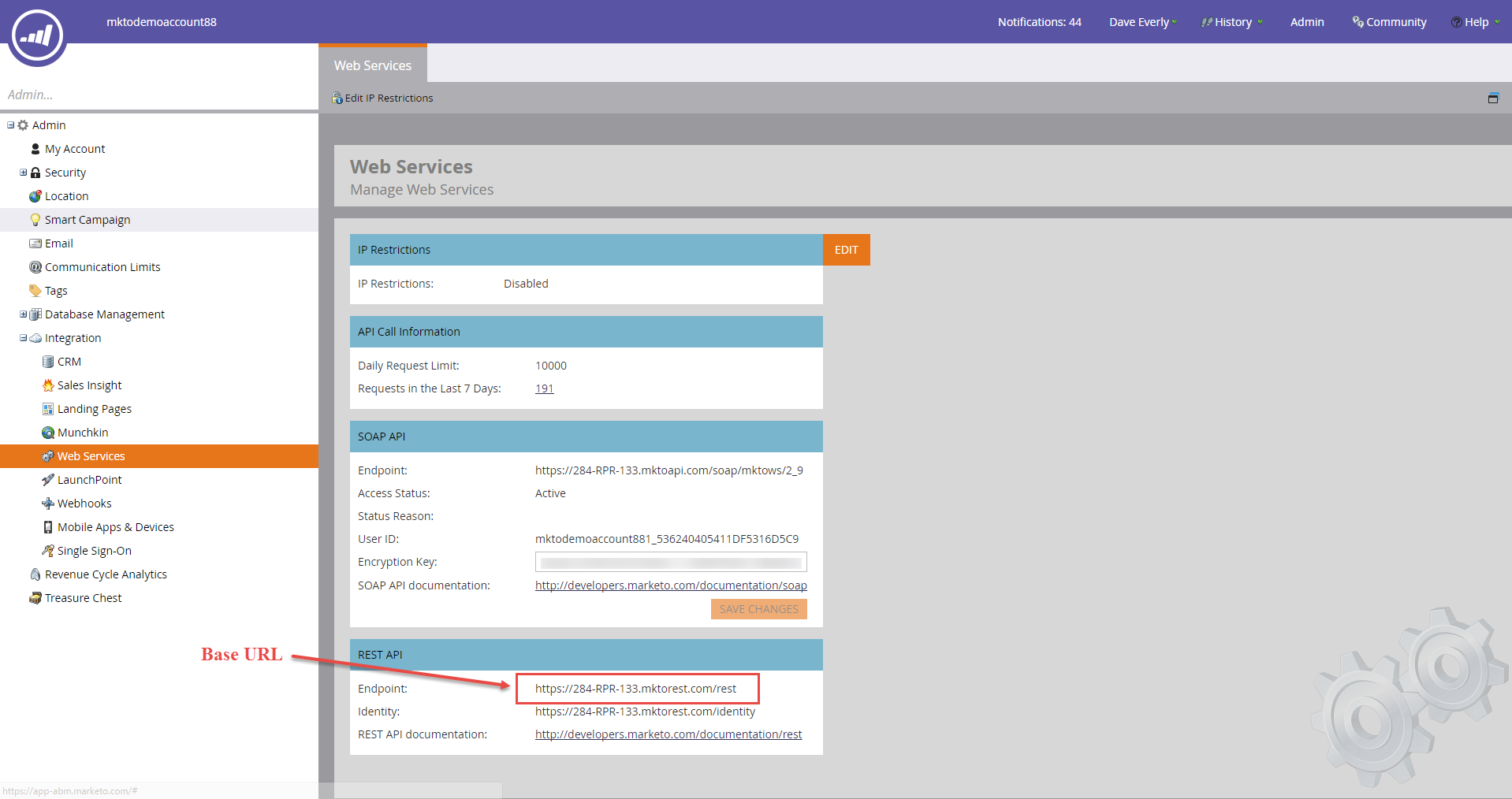
You will need to copy it and send it to Translated.
Retrieving the client ID and client secret
The client ID and client secret are found in Admin > LaunchPoint by selecting the custom service and clicking View Details.
.png?cb=5ecf2455f037e3bbeaf53b4e0d7205ba)
.png?cb=8f9145e71b83095f337e1a32c0ed3408)
You will need to copy both and send them to Translated.
Using the connector
Accessing the intake manager
Log in to the Marketo Engage intake manager with your TranslationOS credentials.
.png?cb=fa0248c9e0f29abc606f872c361c0da0)
Navigating the UI
You can select whether to view marketing campaigns or specific assets in the sidebar.
.png?cb=bd5ceb375199d7475e63885ae631c649)
In the Marketing Activities view, you’re presented with all your marketing campaigns and some metadata: their ID, name, channel, workspace and last modification date. You can filter them by ID, name and last modification date.
.png?cb=348df5325530b0787cca8d264653d1d3)
Under the Design Studio heading, you can select a specific asset type. In the results table, you’ll see all your assets of that type, as well as the ID, name, workspace and last modification date of each asset. They can be filtered by ID or name.
.png?cb=c6e91d1b1433799eff592372e712c588)
To view a program or asset in Marketo Engage, click on its name in the results table.
Requesting translations
In the Marketing Activities or Design Studio view, select the items you want to translate.
Tip: In the Marketing Activities view, make sure to filter by date of last modification, as not all results are displayed by default.
.png?cb=f913c130c69cbbacf1f75cb69ac42d09)
Tip: In the Design Studio view, orders can only be placed for one asset type at a time.
.png?cb=e7590f2ede5c8605d00daec423e08d69)
Once you have selected the content, click New order, then fill in the fields as required.
.png?cb=1be2586ccdb91943a772efa9ea9063fb)
Click on Send order, then Confirm. You’ll then see an order confirmation message.
.png?cb=63250aff7882e272fcfd1433171ff2e1)
Monitoring the translation progress
Once the order has been submitted successfully, the original marketing activities or assets are cloned on Marketo Engage and the target language code is appended to the name. For example, a campaign named Campaign to be translated into Japanese will be cloned and named Campaign ja-JP.
If a folder or asset with that name already exists, a number is appended, so the previous example would become Campaign ja-JP_1.
Once the translation starts, the suffix (in progress) is then appended to the name, so the previous example would become Campaign ja-JP_1 (in progress).
In the connector’s UI, the status of the order changes to queued and then, once bucketing has completed, to in progress.
.png?cb=9b5ecadf856baeb7d02b4206a2bb0cf3)
Receiving the translated content
Once all the associated requests have been delivered, the Translation Status of the relevant items is emptied. The translated assets that were originally cloned are populated with the translated content.
FAQ
How do I track my assets in TranslationOS?
TranslationOS uses abstract concepts like content ID, order ID and order group ID to map your content. The values for these fields change depending on the source platform. To retrieve a Marketo Engage asset in TranslationOS, use the Requests or Content views in TranslationOS and type the asset name or type according to the table below.
Marketing Activities
|
TranslationOS ID |
Marketo Engage value |
Comment |
|---|---|---|
|
Content ID |
program:<program id> |
<asset type>:<asset id> |
|
Order ID |
<program name> |
|
|
Order group ID |
<provided by client when placing order> |
This value is provided in the field labelled How will you track your order? in the order form. By default, it is populated with the timestamp of the current date and time. |
Design Studio
|
TranslationOS ID |
Marketo Engage value |
Comment |
|---|---|---|
|
Content ID |
<asset type>:<asset ID> |
|
|
Order ID |
<asset name> |
|
|
Order group ID |
<provided by client when placing order> |
This value is provided in the field labelled How will you track your order? in the order form. By default, it is populated with the timestamp of the current date and time. |